
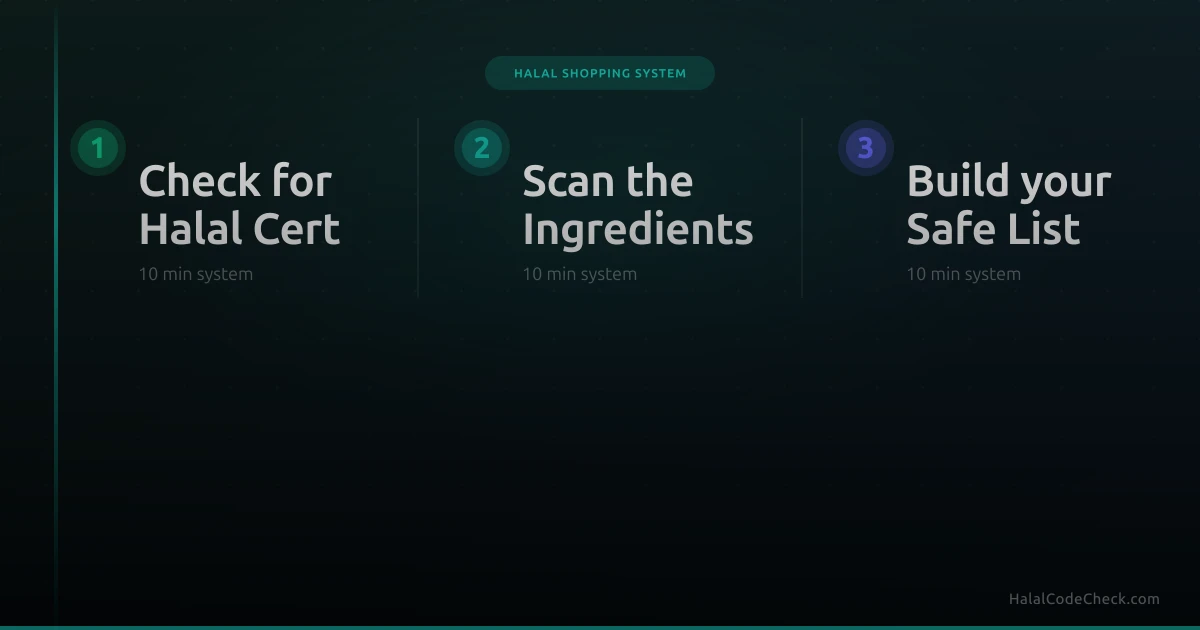
Most halal shopping stress comes from one thing: not having a system.
Without a system, every unfamiliar product requires research. With a system, most products take under 30 seconds to verify - and familiar products take zero seconds because you’ve already done the work.
Here is the full system, step by step.
The 3-Step Check (Use This In-Store)
Step 1 - Look for Halal Certification (5 seconds)
Before reading a single ingredient, check the front and back of the pack for a halal certification logo.
Recognised UK/international bodies:
- HMC (Halal Monitoring Committee) - strict, hand-slaughter focus
- HFA (Halal Food Authority) - widely recognised, accepts stunning with conditions
- IFANCA - North American standard, widely accepted
- MUI - Indonesian standard, common on Southeast Asian products
- Jakim - Malaysian government certification
If you see one of these, the product’s ingredients, processing methods, and supply chain have been verified. Move on.
If there’s no certification mark - proceed to Step 2.
Step 2 - Scan the Ingredient List (15 seconds)
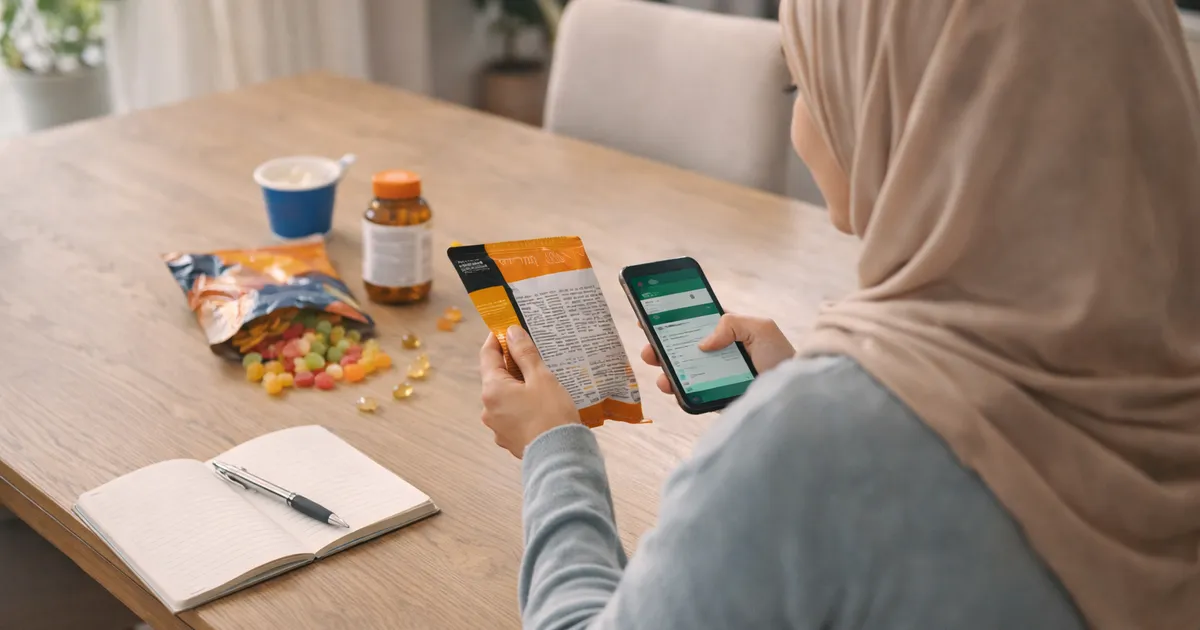
Open HalalCodeCheck, point your camera at the ingredient list, and scan.
The scanner extracts every E-code and additive from the label and shows you the halal status of each one instantly. You don’t need to know what E471, E441, or E120 mean - the app tells you.
If everything comes back green - the declared ingredients are halal. Add to your safe list.
If something comes back amber or red - you have a specific ingredient to investigate, not a vague worry.
If no scanner is available, use the manual check below.
Step 3 - Manual Quick Scan (30 seconds)
If you are not near your phone or prefer a manual check, run your eye down the ingredient list looking for these red flags:
| Ingredient to flag | What it means |
|---|---|
| Gelatin / E441 | Check source - pork is common |
| E120 / Carmine / Cochineal | Always haram (insect-derived) |
| E471 / Mono and Diglycerides | Check source - may be animal-derived |
| E904 / Shellac / Confectioner’s glaze | Insect-derived coating |
| E422 / Glycerol | Check source if no halal cert |
| ”Animal fat” with no species | Treat as questionable |
| E920 / L-Cysteine | May be from human hair or feathers |
| ”Natural flavour” in a meat product | Verify if no halal cert |
| Rennet (in cheese) | Check for “vegetarian rennet” |
If you spot any of these without halal certification, either verify (Step 2) or choose an alternative.
Building Your Safe List (The Part Most People Skip)
The 3-step check is for unfamiliar products. Your goal is to run it as few times as possible.
How to build your safe list:
- First week - verify every product you regularly buy. Takes 20–30 minutes total.
- Add confirmed products to a note - brand, product name, result. Phone notes, a shopping app, or a simple list works fine.
- From week 2 onwards - only check new products. Your regular basket is already verified.
- Re-check when formulas change - manufacturers update recipes. Check again if the packaging says “new recipe” or “improved formula.”
Most families reach a stable safe list within 3–4 weeks. After that, a typical weekly shop requires checking 2–3 new items, not 30.
Category-by-Category Risk Guide
Not all aisles carry the same risk. Here is where to spend your verification time:
🔴 High Risk - Always Verify
- Sweets and confectionery - gelatin, E120, E441, shellac
- Supplements and vitamins - soft gel capsules (gelatin), gummies
- Meat and poultry - requires halal certification; slaughter method matters
- Cheese - animal rennet is common in hard varieties
🟡 Medium Risk - Check Once
- Bread and baked goods - E471, E920, animal fat
- Yogurt and dairy desserts - gelatin thickeners, E120 in fruit varieties
- Crisps and snacks - flavour systems, E471
- Ready meals - meat extracts, E471, flavourings
🟢 Low Risk - Rarely a Concern
- Fresh fruit and vegetables - always halal
- Plain rice, pasta, flour - always halal
- Butter, plain milk, plain cream - halal (no additives)
- Eggs - always halal
- Plain canned goods (beans, tomatoes) - usually halal; check added flavourings
At the Deli and Butcher Counter
For loose meat and deli items, the label isn’t enough. You need:
- Dedicated halal butchers - the most reliable. Ask if they are HMC or HFA certified.
- Supermarket halal sections - verify the certification body. Labeling varies significantly between retailers.
- Deli counter meats - avoid unless from a certified halal butcher or with visible halal certification on the packaging.
When You Are Unsure In-Store
Three options when you are standing in the aisle and not sure:
- Put it back and choose an alternative - safer option now, verify later at home
- Scan it instantly - 15 seconds with your phone
- Check the brand website - most major brands have a “allergens and ingredients” FAQ that often answers the halal question
The default when in doubt: choose the alternative. The goal is not to verify every product in the store - it is to make confident decisions fast. When confident becomes uncertain, grab the safer product.
Frequently Asked Questions
How long does halal grocery shopping actually take?
Once you have a safe list, a regular weekly shop takes no extra time compared to non-halal shopping. The investment is front-loaded - a couple of weeks of verification, then it is mostly automatic.
Do I need to check every single ingredient?
No. You are looking for the red flags listed above. Most ingredients in most products are completely fine. The goal is catching the small number of problematic ones, not auditing every line.
What if the manufacturer doesn’t respond to queries?
Choose a different brand. There are almost always halal-certified alternatives in every category. Not getting a clear answer from a manufacturer is itself an answer - choose products where the information is available.
Is “suitable for vegetarians” enough?
It is a useful indicator but not a halal guarantee. It rules out meat and most gelatin, but not insect-derived colours (E120, shellac), alcohol-based flavourings, or non-zabiha processing. Use it as a starting filter, then verify the specific red flags. Full explanation: Why vegetarian doesn’t always mean halal.
Should I use multiple halal apps?
You only need one reliable one. Having multiple creates inconsistency when different databases disagree. HalalCodeCheck covers 370+ E-codes with source verification - use it consistently and trust the results.
Your Action Plan
This week:
- Do a one-time verification of your regular weekly basket - use the ingredient scanner on each product
- Note the safe ones in a list
- Flag anything that needs more research
From next week:
- Only scan new products you haven’t verified before
- Re-check products that show “new recipe” on the pack
Within a month, halal shopping will take the same amount of time as regular shopping - with the confidence of knowing what you are buying.
Related Articles
 Ingredients
 15 Haram Ingredients Hiding in Everyday Groceries (Most Shoppers Miss These)
From gelatin to L-cysteine, these 15 ingredients are in products most Muslim shoppers consider safe. Learn exactly where they hide and how to spot them fast.
 How-To Guides
 The Most Searched Halal Food Questions, Answered Clearly
Straight answers to common halal food questions Muslims search for every week, from gelatin and E-codes to vegetarian labels and accidental mistakes.
 Ingredients
 Is Agar Agar Halal? Yes - The Seaweed Gelling Agent That's Always Safe
Agar agar (E406) is 100% halal - plant-derived from red seaweed with no animal processing. Learn where it's used, how it compares to gelatin, and how to spot it on labels.
Stay updated 🌿
New E-codes, brand guides & halal alerts — no spam.
Ready to verify E-codes instantly?
Stop guessing about food ingredients. Use HalalCodeCheck to scan products and get instant halal verification.